
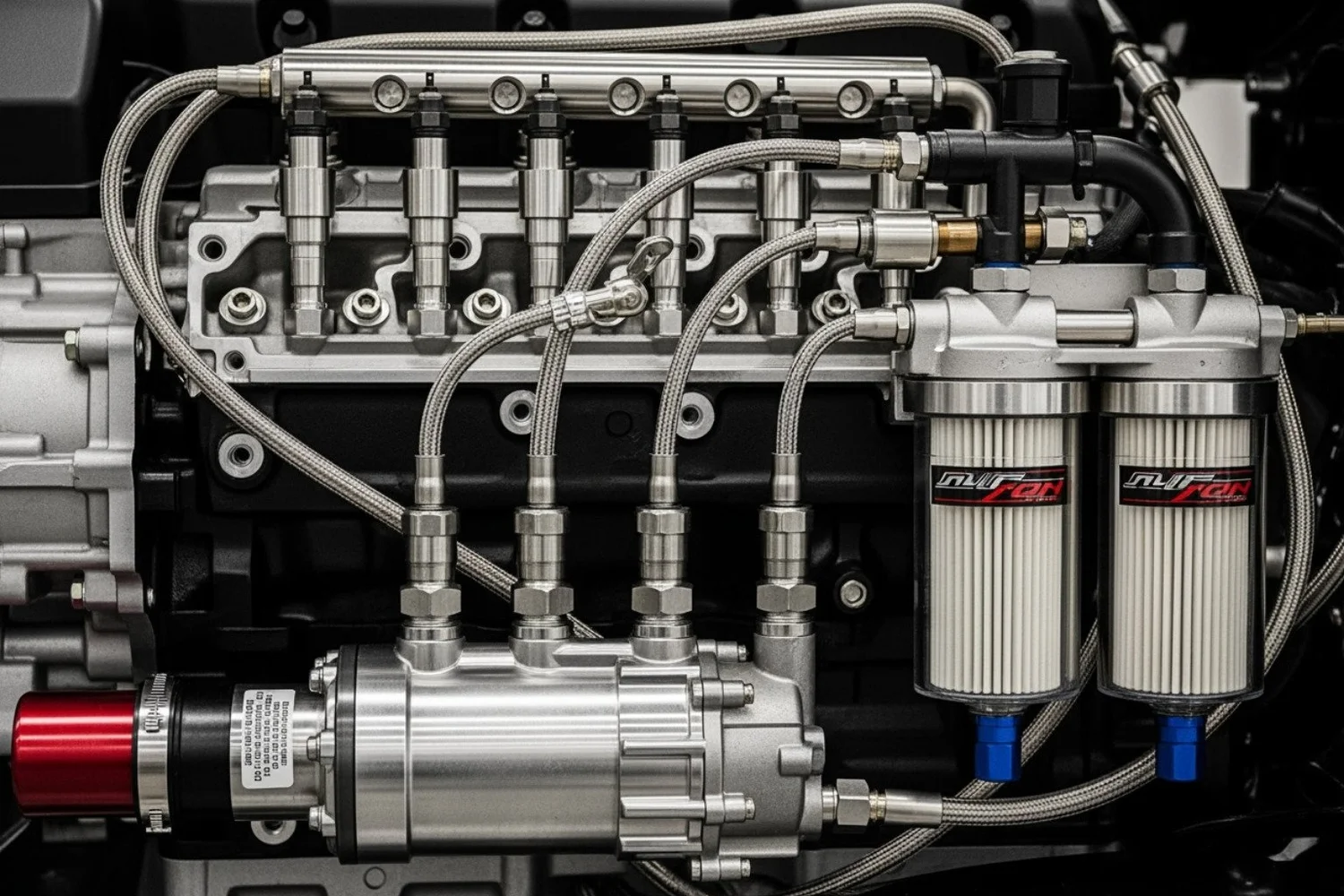
Upgrading Your Deadhead Fuel System for Turbocharging
Adding a turbocharger to an engine equipped with a deadhead fuel system presents a critical challenge that, if mismanaged, can lead to severe engine damage. This guide provides a definitive pathway to safely and effectively upgrade your fuel delivery, ensuring it meets the demanding requirements of forced induction and unlocks your engine’s performance potential. Proper system conversion is essential for both power and reliability.
Understanding Deadhead Fuel System Limitations for Turbocharging
A deadhead fuel system delivers fuel directly from the pump to the fuel rail, with a pressure regulator typically at the rail’s end and no fuel returning to the tank. While adequate for naturally aspirated setups, this design is fundamentally incompatible with the increased fuel demands of turbocharging.

The main issues stem from two critical points: insufficient fuel volume and inadequate pressure regulation under boost. Turbocharged engines require a significantly higher flow rate of fuel to prevent lean conditions, which can cause detonation and catastrophic engine failure. A deadhead system struggles to maintain consistent fuel pressure and volume across the injectors as boost increases. Moreover, without a return line, fuel constantly recirculates within the hot engine bay, leading to heat saturation, reduced fuel density, and potential vapor lock. The fixed-pressure regulator also cannot compensate for changing manifold pressures, resulting in an inconsistent fuel pressure differential across the injectors and unreliable fueling.
Key Takeaway: Deadhead fuel systems lack the flow, pressure regulation, and cooling capacity required for safe and effective forced induction.
Essential Components for a Turbocharged Fuel System
Converting a deadhead system for turbocharging requires a comprehensive upgrade of key components to ensure reliable fuel delivery under all conditions. Each element is crucial for maintaining consistent performance and engine safety.
- High-Flow Fuel Pump: Crucial for delivering the significantly increased volume of fuel required by a boosted engine. Often an aftermarket in-tank or external unit, it must be sized to support your target horsepower.
- Larger Fuel Injectors: Essential for supplying sufficient fuel mass per combustion cycle. Injector size (e.g., lbs/hr or cc/min) must be precisely matched to your engine’s needs and target power.
- Boost-Referenced Fuel Pressure Regulator (FPR): This component replaces the deadhead regulator. It features a vacuum/boost port that connects to the intake manifold, allowing fuel pressure to increase proportionally with boost (typically 1:1 ratio). This maintains a constant differential pressure across the injectors, ensuring accurate fuel delivery regardless of manifold pressure.
- Upgraded Fuel Lines: Stock lines are usually too small. Larger diameter AN lines (e.g., -6AN, -8AN for supply and return) are necessary for higher flow rates. Material compatibility with your chosen fuel, especially E85, is also vital.
- Return-Style Fuel Rail: While some stock rails can be adapted, an aftermarket rail often provides superior flow distribution, proper mounting points for injectors and FPR, and dedicated ports for both supply and return.
Key Takeaway: A complete component overhaul, including a high-flow pump, larger injectors, a boost-referenced FPR, upgraded lines, and often a new fuel rail, forms the foundation of a safe turbocharged fuel system.
Converting to a Return-Style System and Professional Tuning
The transformation from a deadhead to a return-style fuel system is a detailed mechanical undertaking culminating in indispensable professional electronic control unit (ECU) tuning.
Here’s a step-by-step guide to this critical upgrade:
- Plan and Select Components: Meticulously plan your system layout, choosing components (pump, injectors, FPR, lines) precisely sized for your engine’s target horsepower and fuel type. Proper planning prevents installation headaches and ensures future expandability.
- Install High-Flow Fuel Pump: Securely install your new high-flow fuel pump, either in-tank or externally. Ensure the pump wiring is upgraded with a dedicated relay and appropriate gauge wire to handle its increased electrical demands.
- Route and Install New Fuel Lines: Install the new, larger diameter supply and return fuel lines. The supply line runs from the pump to the fuel rail, and the return line connects the boost-referenced FPR back to the fuel tank. Ensure proper routing away from heat and abrasion points, securing them with appropriate clamps.
- Install Fuel Rail and Injectors: Mount the upgraded fuel rail (if necessary) and install the larger fuel injectors with new O-rings. Confirm they seat properly to prevent leaks. Connect the supply line to the fuel rail inlet.
- Install Boost-Referenced Fuel Pressure Regulator: Position the FPR at the end of the fuel rail (on the return side). Connect the fuel rail outlet to the FPR inlet, and the FPR outlet to your new return line to the tank. Crucially, connect the FPR’s vacuum/boost port directly to a reliable source on the intake manifold, post-throttle body, ensuring it senses manifold pressure accurately.
- Leak Checks and Initial Startup: Before full operation, cycle the ignition several times to prime the system and meticulously inspect all connections for fuel leaks. Correct any leaks immediately.
- Professional ECU Tuning: This is the most critical final step. A qualified tuner will use an aftermarket or modified stock ECU to recalibrate your engine’s fuel maps, ignition timing, and boost control. They will optimize air-fuel ratios (AFR) under all load and boost conditions, set safety limits (e.g., boost cut, rev limiter), and ensure the engine operates efficiently and safely. Relying on generic tunes or skipping this step will inevitably lead to engine damage.
Key Takeaway: A successful conversion requires precise component installation for the return-style system, followed by non-negotiable professional ECU tuning to ensure optimal, safe, and reliable engine operation under boost.
Essential Considerations for a Turbocharged Fuel System
- Fuel Type Compatibility: Verify all components are rated for your specific fuel (e.g., E85 requires special materials).
- Electrical System Upgrade: Ensure your vehicle’s electrical system can support the higher current draw of the new fuel pump.
- Fuel Filter Placement: Install appropriate pre-pump and post-pump fuel filters to protect the pump and injectors.
- Heat Management: Isolate fuel lines and components from excessive engine bay heat to prevent fuel heating and vapor lock.
- Engine Internals: Assess if your engine’s internal components (pistons, rods) can handle the increased power and stress from turbocharging.
- Monitoring Gauges: Install and regularly monitor critical gauges like wideband AFR, fuel pressure, and EGT for engine health.
- Intercooler Sizing: Ensure your intercooler is adequately sized to cool compressed air, contributing to engine safety and power.
Common Mistakes to Avoid
- Under-Sizing Fuel System Components: Insufficient fuel pump, injectors, or lines will cause lean conditions and engine failure.
- Neglecting the Return Line: Without a return, fuel overheats and pressure regulation is impossible, leading to catastrophic failure.
- Omitting a Boost-Referenced FPR: Essential for maintaining correct fuel pressure differential under varying boost levels.
- Improper Fuel Pump Wiring: Using undersized wire or no relay can lead to voltage drop, pump failure, or even electrical fires.
- Skipping Professional Tuning: The most common and dangerous mistake, leading to poor performance and guaranteed engine damage.
- Poor Line Routing: Running lines too close to exhaust or sharp edges, risking melting, chafing, or leaks.
- Ignoring Fuel Filters: Contaminants can quickly clog injectors or damage the fuel pump, leading to system failure.
FAQ Section
What are the immediate signs of an under-fueled turbocharged engine?
Immediate signs of an under-fueled turbocharged engine often include a sudden loss of power under boost, engine hesitation, backfiring, and an audible “pinging” or knocking sound, which is detonation. If you have a wideband air-fuel ratio (AFR) gauge, it will display a very lean reading (e.g., 13:1 AFR or higher under boost), which is a critical warning sign that requires immediate action to prevent severe engine damage.
Can I adapt my existing stock fuel rail for a return-style setup?
While it’s technically possible to adapt some stock fuel rails, it’s often not ideal or recommended for high-performance turbocharged applications. Adapting typically involves drilling and tapping the rail for a return line fitting and ensuring proper flow distribution. Aftermarket return-style fuel rails are designed for high flow, better injector distribution, and provide convenient ports for the FPR and fuel pressure gauges, offering a more robust and reliable solution for consistent fueling under boost.
How often should I check my upgraded fuel system after installation?
After initial installation and professional tuning, it’s crucial to perform regular visual inspections. Check all fuel lines, fittings, and connections for leaks or signs of wear during routine maintenance or oil changes. Monitor your fuel pressure gauge and wideband AFR gauge constantly while driving, especially under boost. Any deviation from normal operating parameters should prompt an immediate investigation. A good practice is a thorough inspection every 3,000-5,000 miles or before any track events.