
Engineering Optimal Illumination in Commercial Workspaces
Effective commercial office lighting extends beyond aesthetics, directly impacting occupant comfort, productivity, and energy consumption. A data-driven approach, considering metrics such as illuminance, color rendering, and glare control, is paramount for successful implementation. This analysis delves into the technical considerations and trade-offs involved in designing high-performance illumination systems for modern work environments.
Fundamental Metrics and Standards
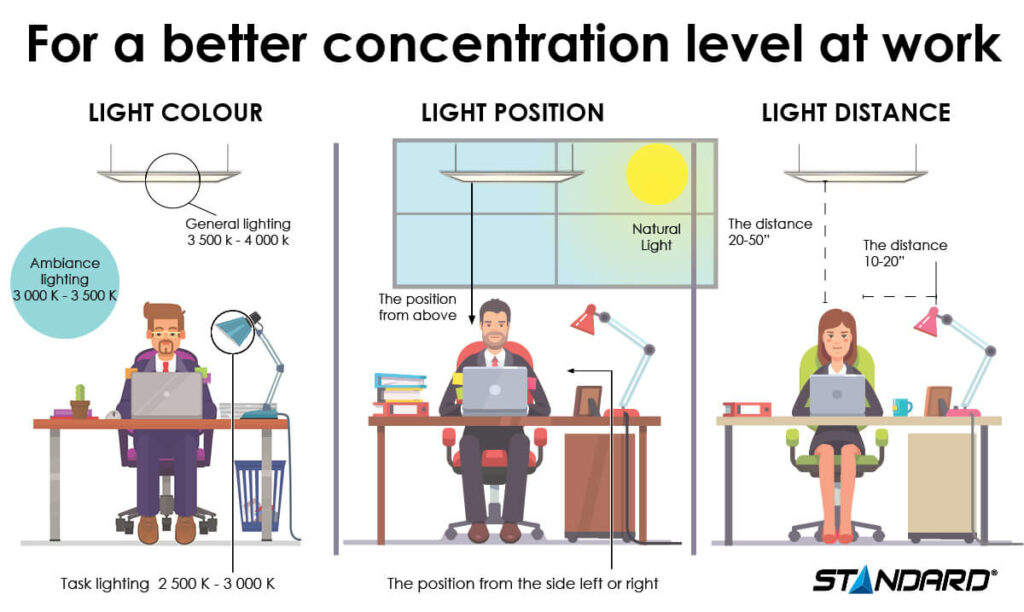
Effective commercial office lighting relies on quantifiable metrics and industry standards. Illuminance, in lux (lumens per square meter), dictates the light quantity on a surface. EN 12464-1 recommends 500 lux on the work plane for general tasks, with a uniformity ratio (minimum to average) of at least 0.7. Color Rendering Index (CRI or Ra), from 0-100, quantifies color accuracy; >80 CRI is typically mandated to ensure accurate color perception. Correlated Color Temperature (CCT), in Kelvin, describes light ‘warmth’; 4000K-5000K promotes alertness in office settings. Critically, the Unified Glare Rating (UGR) addresses discomfort glare; <19 is the threshold for workstations. Failing these, e.g., designing for 700 lux without UGR <19 compliance or specifying <80 CRI, compromises visual acuity and occupant satisfaction despite potential initial cost savings.
Lighting Technologies and Control Systems
Modern office lighting is dominated by Light Emitting Diodes (LEDs), offering superior efficacy and lifespan over legacy fluorescent lamps. Contemporary LED luminaires often achieve >130 lumens per watt (lm/W), significantly surpassing the 70-85 lm/W of T8 fluorescents. This efficiency reduces lighting power density by 40-60%. LED lifespans (L70 B50) typically range from 50,000 to 100,000 hours, extending beyond 20,000-30,000 hours of fluorescents, thereby lowering maintenance costs.

Sophisticated control systems are crucial. Digital Addressable Lighting Interface (DALI) enables individual luminaire control and precise 0.1-100% dimming, unlike older 0-10V systems with less granular, zone-level control (10-20% minimum dimming). Networked systems integrate occupancy sensors, reducing energy consumption by 20-30% in intermittently occupied spaces, and daylight harvesting sensors, yielding 15-25% savings in perimeter zones. While advanced controls incur a 15-25% higher initial capital expenditure per luminaire, operational savings often accelerate payback periods.
Ergonomic Considerations and Human-Centric Design
Beyond quantitative light levels, ergonomic and human-centric design addresses occupant well-being. Discomfort glare (UGR >19) in task areas demonstrably increases eye strain and reduces productivity. Luminaire optics, such as micro-prismatic diffusers or parabolic louvers, are critical for achieving UGR <19, often with a minor efficacy trade-off compared to unshielded designs. This trade-off is justified by improved visual comfort.
The spectral power distribution (SPD) influences circadian rhythms. Blue light (450-490 nm) significantly suppresses melatonin, impacting sleep cycles. Tunable white LED systems (2700K-6500K) dynamically adjust CCT and spectral content (e.g., 5000K in the morning to 3000K in the afternoon) to support circadian entrainment. These systems command a 30-50% premium over fixed-CCT LED solutions. Flicker, often imperceptible but biologically impactful, must be minimized; high-quality LED drivers achieve >120 Hz, ideally >400 Hz, preventing headaches and eye strain commonly associated with low-cost, unregulated drivers.
Energy Efficiency and Operational Costs
Optimizing energy efficiency is central to commercial office lighting design. Lighting Power Density (LPD), in watts per square foot (W/sf) or per square meter (W/m²), is regulated by energy codes like ASHRAE 90.1, with open office targets around 0.40-0.60 W/sf. Designing below these, e.g., achieving 0.35 W/sf via high-efficacy LEDs and granular controls, can reduce the lighting component of a building’s electricity bill by 50-70% compared to legacy systems.
Initial capital expenditure for high-efficiency, intelligently controlled systems is typically 20-40% higher than for basic compliant systems. A Total Cost of Ownership (TCO) analysis is essential, factoring capital, energy, and maintenance. An LED upgrade at $5-8/sf might have a 3-5 year energy payback, with total life cycle savings (over 10-15 years) often 2-3 times the initial investment. Furthermore, selecting luminaires with a high Power Factor (PF >0.9) and low Total Harmonic Distortion (THD <20%) for drivers, while potentially adding 5-10% to unit cost, prevents adverse impacts on electrical infrastructure and avoids potential utility penalties.
| Feature/Metric | Linear Fluorescent (T8/T5) | Standard LED Panel (Fixed CCT) | Advanced Tunable White LED System |
|---|---|---|---|
| Typical Efficacy (lm/W) | 70-90 | 110-140 | 90-120 |
| Average Lifespan (L70, hrs) | 20,000-30,000 | 50,000-75,000 | 40,000-60,000 |
| CRI (Ra) | >80 | >80, often >90 available | >80, often >90 available |
| CCT Range (K) | 3000K, 3500K, 4000K, 5000K (fixed) | 3000K, 3500K, 4000K (fixed per luminaire) | 2700K-6500K (dynamic adjustment) |
| Glare Control (UGR) | Requires external louver; UGR 19-22 typical | Often UGR <19 with prismatic lenses | Often UGR <19 with prismatic lenses |
| Dimming Capability | Analog (0-10V) or DALI (specific ballast); 10-100% | Analog (0-10V) or DALI; 1-100% (down to 0.1% with DALI) | DALI or proprietary network; 0.1-100% with spectral control |
| Initial Capital Cost (Relative) | Low (Reference: 1.0x) | Medium (1.5x – 2.5x) | High (2.5x – 4.0x) |
| Energy Savings Potential (vs. Fluorescent) | Baseline | Significant (40-60%) | Very High (50-75%) with controls |
| Maintenance Frequency | High (lamp/ballast replacement) | Low | Low |
- Conduct a thorough pre-design light level and glare survey, particularly in existing spaces, to establish a quantitative baseline for improvement.
- Prioritize luminaires with verified Unified Glare Rating (UGR) <19 for open office and task-intensive areas to mitigate visual discomfort.
- Specify LED drivers with a Power Factor (PF) exceeding 0.9 and Total Harmonic Distortion (THD) below 20% to ensure electrical system compatibility and efficiency.
- Implement a networked lighting control system with granular zoning, integrating both daylight harvesting and occupancy/vacancy sensors, aiming for 15-30% additional energy savings.
- Integrate emergency lighting components, including battery backup or central inverter systems, early in the design phase to comply with life safety codes (e.g., NFPA 101, local building codes) and ensure proper light levels during power outages.
- Verify photometric performance post-installation through on-site light meter measurements to confirm adherence to design specifications and address any deviations.
- Consider the long-term maintainability, including driver replacement accessibility and module obsolescence, when selecting specific luminaire families.